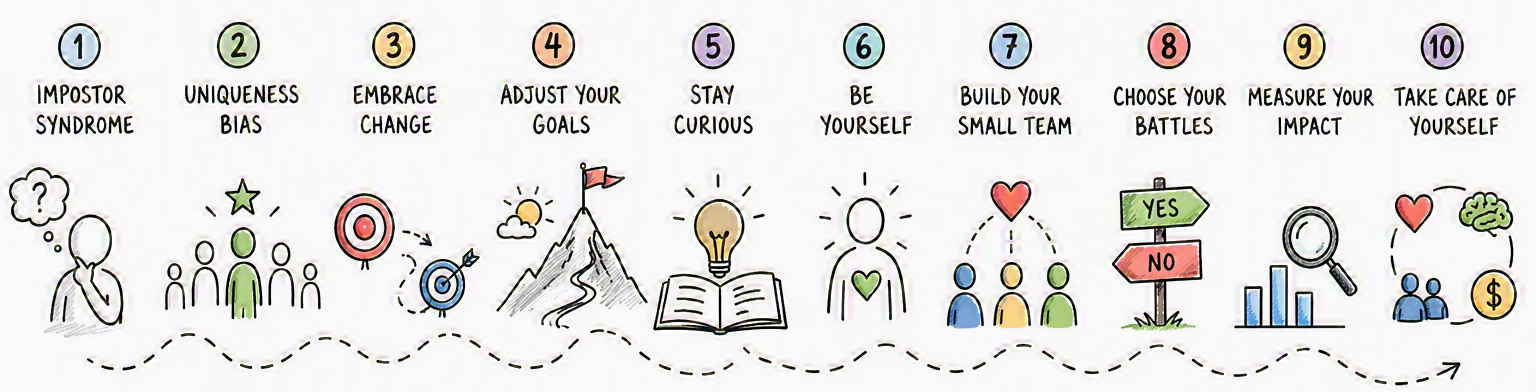
Ten lessons learned from ten years at Microsoft
July always invites reflection at Microsoft: with the new fiscal year, goals and priorities change and, sometimes, so do teammates or managers. Before focusing on the new year and the summer break, I looked back and realized that this is my tenth July at the company, something I honestly never thought I would reach. Maybe the first July should not count, because back then I was mostly focused on not getting fired before August, but here we are anyway.
A lot has happened in these 10 years, both personally and professionally: some achievements, plenty of setbacks, and many lessons I did not always understand the first time around. I think there is something to learn from all of it, if not to avoid the obstacles, at least to be better prepared next time. These are the reflections I have arrived at over the last few days, and I am sharing them mostly for myself, so I can return to them in less optimistic times.
Impostor syndrome. Get to know it. Make friends with it, but do not let it make decisions for you. It never really goes away, and it can keep you grounded when managed well. Use it to challenge your ideas, but make your own decisions and do not confuse doubt with lack of judgment.
Choose your battles. If you say yes to everything, you will end up doing nothing that matters.
Addendum: Remember the opportunity cost. Every commitment you accept means giving up the alternatives.
Embrace change. You are always aiming at a moving target. What looks like the most critical and strategic priority today can change next quarter. As David Alayon points out: in this world of radical uncertainty, we often look for solutions to problems that no longer exist.
Corollary #1: Do not put all your eggs in one basket.
Corollary #2: Enjoy what you enjoy, because you never know how long it will last. The opposite is also true.
Adapt your goals to your circumstances. Not every year can be your best year, and that is okay. Life happens. Adjusting your goals is not giving up; it is choosing a more sustainable way to move forward. Do not compare your worst moments with the best version that others choose to share. Even better: do not compare yourself with anyone. It is easier, healthier, and more sustainable in the long term.
Corollary: The motivation trap: You cannot be motivated all the time, and you do not need to be. Sometimes motivation comes from outside work. You are not defined by your job description.
Stay curious. Curiosity is more useful than knowledge. The first leads to the second.
Corollary: When you are in the right place, there is always someone who knows more than you. That is a good sign. Dare to take some risks; it is usually worth it.
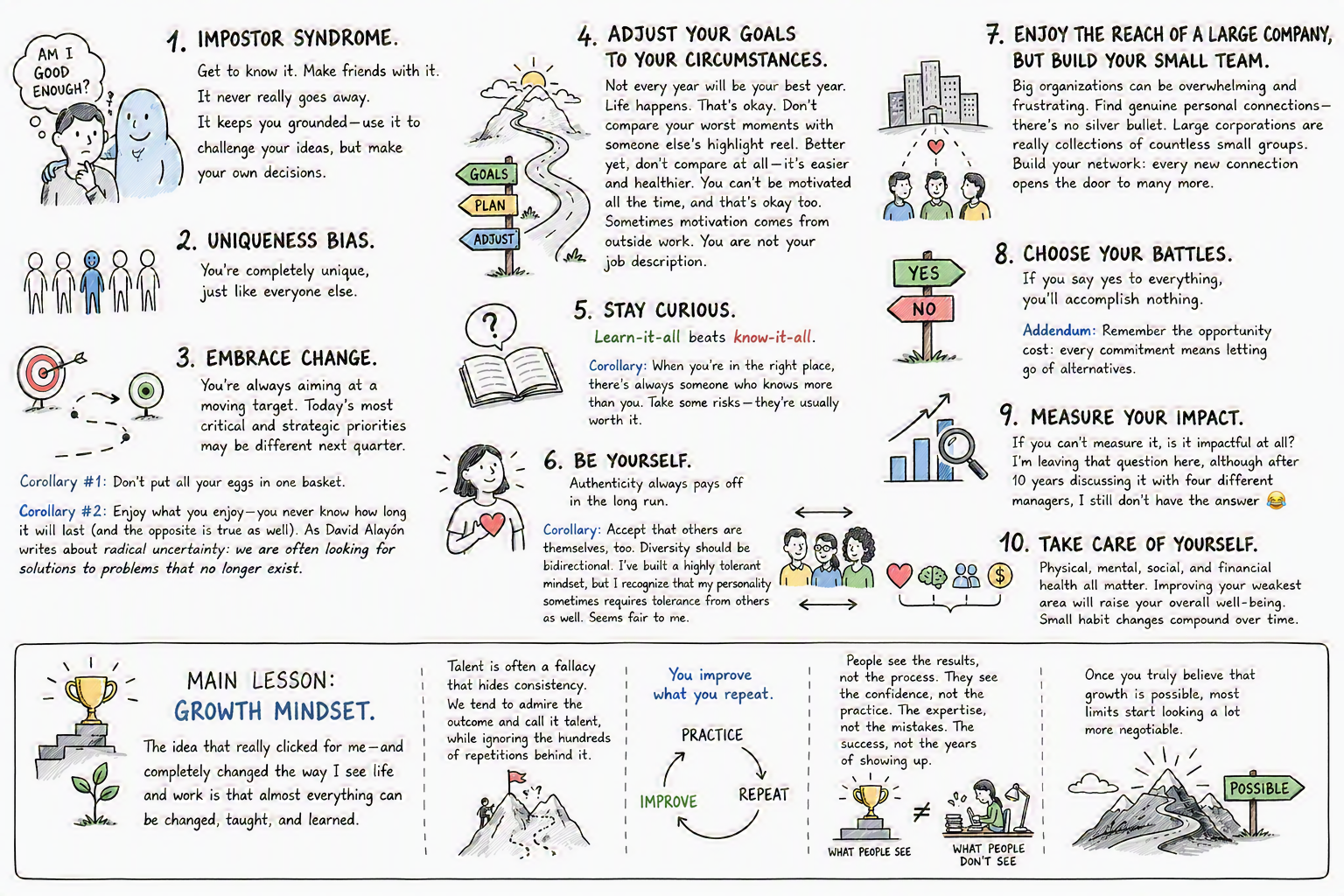
Be yourself. Authenticity always pays off in the long run.
Corollary: Accept that others get to be themselves, too. Diversity should be bidirectional. In my case, I have built a high tolerance for ways of thinking and acting that are very different from mine. At the same time, I recognize that my personality also requires a certain level of tolerance from others. That seems fair to me.
Take advantage of your company’s reach but build real personal connections that can survive organizational changes. Big organizations can be overwhelming and frustrating (often they are), but they work as a sum of small groups. Build your network: every new node multiplies the number of possible connections exponentially.
Uniqueness bias. You are completely unique, just like everyone else.
Measure your impact. If you cannot measure it in any way, it is worth asking whether it is really impact. And if you can measure it, it is also worth asking whether you are measuring what matters.
I am leaving that question unanswered for now. After ten years of discussing it with nearly as many managers, I still do not have a clear answer :)
Take care of yourself. Physical, mental, social, and financial health matters. Every part counts. Improving your weakest area is often the fastest way to improve your overall well-being. Also, small habits add up over time.
And the most important takeaway: develop a growth mindset. The idea that completely changed the way I understand life and work is that almost everything can be changed, taught, and learned. Talent is often a fallacy that hides pure consistency. We admire the result and call it talent, while ignoring the iterations and practice behind it.
You improve what you repeat. Others see the outcome, not the process; the confidence in yourself, not the hours of practice; the experience, not the mistakes or the years of silent effort.
When you truly internalize that you can learn and improve at anything, most of your limits become negotiable.
What do you think? If you want, leave me a comment or send me a private message on LinkedIn!